X-Rays: Principles, Interactions, and Applications

Introduction
X-rays are a form of electromagnetic radiation widely used in science, medicine, and industry. Since their discovery, they have become an essential tool for exploring the internal structure of matter without causing damage. This article explains the fundamental principles of X-rays, their interactions with matter, and their most important applications.
What Are X-Rays?
X-rays are high-energy electromagnetic waves with wavelengths shorter than visible light. Because of their high energy, they can penetrate materials that are opaque to visible radiation.
They are typically produced in:
- X-ray tubes, where fast electrons strike a metal target.
- Atomic transitions involving inner-shell electrons.
X-rays are generally classified into:
- Characteristic X-rays → emitted when electrons transition between atomic energy levels.
- Bremsstrahlung (braking radiation) → produced when electrons are decelerated near atomic nuclei.
Interactions of X-Rays with Matter
When X-rays interact with matter, several physical processes can occur:
1.Photoelectric Effect
- The X-ray photon is completely absorbed
- An inner-shell electron is ejected
- This process is dominant at lower energies
2.Compton Scattering
- The photon collides with a loosely bound or free electron
- Energy is partially transferred
- The photon changes direction
3.Elastic (Rayleigh) scattering
- The photon is scattered without losing energy
- Only its direction changes
These interactions depend on the photon energy and the atomic number (Z) of the material.
Characteristic X-Rays
When an inner-shell electron is removed, a vacancy is created. An electron from a higher energy level fills this vacancy, emitting a photon with a specific energy.
This leads to spectral lines such as:
- K-lines (Kα, Kβ)
- L-lines (Lα, Lβ, Lγ)
Each element has unique characteristic X-rays, which makes this phenomenon extremely useful for elemental identification.
Applications of X-Rays
X-rays have many important applications:
- Medical Imaging
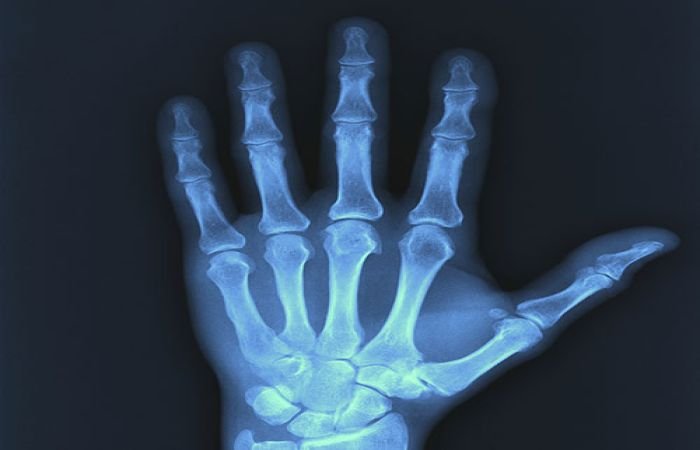
- Used in radiography and CT scans to visualize bones and internal organs
- Material Analysis (XRF)
- Determines the elemental composition of materials in a non-destructive way
- Industrial Inspection
- Detects defects in metals and structures
- Security
- Used in airport scanners to inspect luggage
- Scientific Research
- Helps study atomic structure and material properties
Advantages of X-Rays
- Non-destructive analysis
- High penetration power
- Fast and accurate results
- Applicable to solids, liquids, and powders
Conclusion
X-rays are a powerful and versatile tool in modern science and technology. Their ability to probe the internal structure of matter without causing damage makes them indispensable in many fields. Understanding their principles and interactions with matter is essential for improving their applications and developing new technologies.
Comment

Maissa Chemlal
An excellent summary of X-rays !It clearly explains their production, interaction like Compton Scattering, and vital applications in medical imaging and security. A very helpful guide to understanding this indispensable scientific tool.🌸🪷🏵️

Tasnim Aliya Bouziane
Your right. X-rays are a powerful and versatile tool in modern science and technology. Thank you for your article 🥰
Amina Lazrag
Thanks for shedding some light " !on home X-rays work"💜